
The Trial of Jesus of Nazareth is the ultimate psychological drama. At its center are three figures: a Roman governor trapped by political survival, a violent insurrectionist who walked away free, and an innocent man who took his place.
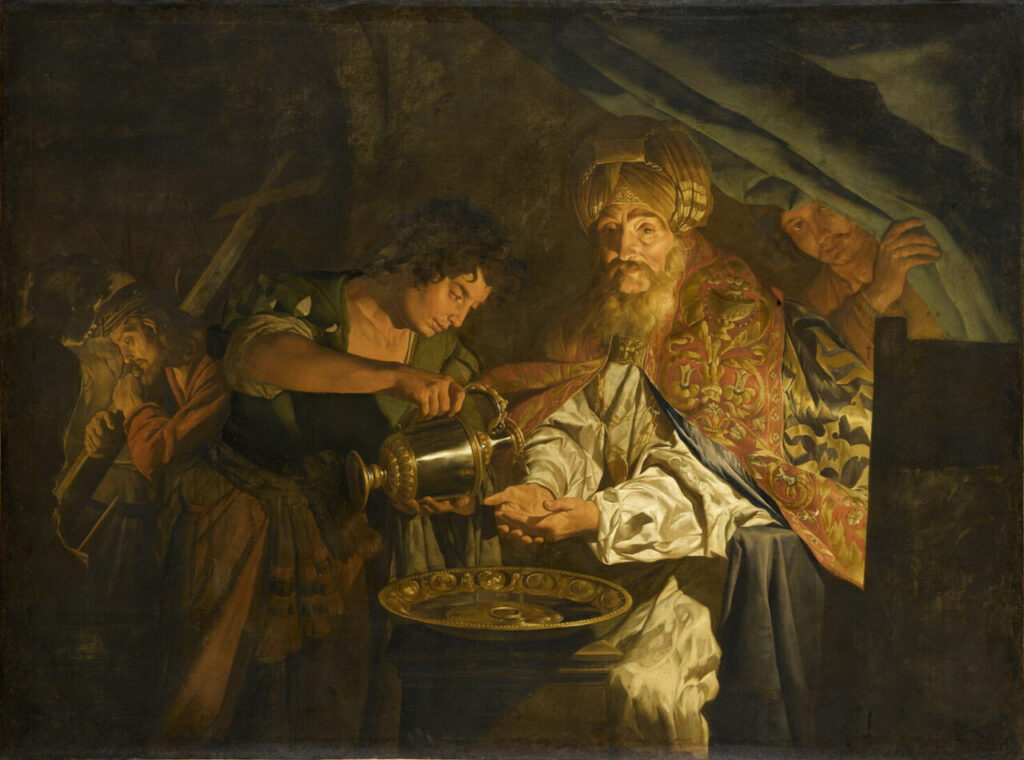
Claudia’s Warning and Pilates Dilemma Pontius Pilate was trapped between Roman justice and political survival. The pressure didn’t just come from the angry crowd outside- it came from inside his own home. Right in the middle of the trial, a messenger rushed up to Pilate with an urgent note from his wife, Claudia Procula.
She begged him to back off, warning: “Have nothing to do with that righteous man; for I have suffered much in a dream today because of him.” Disturbed by his wife’s dream, Pilate tried to understand the mysterious man before him in a private interrogation: Pilate: “Do you not speak to me? Do you not know that I have the power to crucify you, and power to release you?” Jesus: “You would have no power at all against me unless it had been given you from above.”
Jesus revealed a chilling truth: Pilate wasn’t actually in control. His wife’s supernatural dream and his own political panic were all parts of a cosmic narrative. Pilate was chosen for this exact, terrifying moment. He washed his hands, but the water couldn’t wash away the weight of his choice.
Barabbas: The Remorseless Exchange Barabbas’s name literally translates to “Son of the Father” (Bar-Abba). The crowd rejected the true Son of the Father to save a violent imitation. Barabbas walked away untouched by guilt, while the only truly guiltless man stepped onto the executioner’s block. This is the ultimate picture of Barabbas not caring of having any shame. While Jesus sacrificed for even a harden criminal.
Ultimately, the contrasting response of Pontius Pilate and Barabbas highlight the complex human reactions to the crucifixion of Jesus. Pilate’s profound dilemma reflects the heavy burden of political compromise, public pressure, and a troubled conscience that water could not wash away. In stark contrast, Barabbas embodies a complete absence of guilt or shame, walking away free while an innocent man literally paid the ultimate price in his place. Together, their stories powerfully illustrate the paradox of the crucifixion: one man crushed by the moral weight of his choice, and another entirely untouched by the grace of a substitute sacrifice.
Pilate didn’t understand the burden of his dilemma and how he would live with his choice had not been placed on his shoulders. God had chosen him for this very moment.
Leave a Reply